Evaluating Reindeer Colorful: A Practical Guide to Festive Display Typography
When designing for the holiday season, typography often carries as much weight as imagery. The choice of font sets the emotional tone immediately, signaling whether a project is elegant and traditional or bold and whimsical. Reindeer Colorful emerges as a distinct option within the festive design landscape, specifically catering to projects that require a high-energy, playful aesthetic. Unlike standard serif or sans-serif typefaces that prioritize legibility at small sizes, this display font is engineered for impact, utilizing a chunky, hand-drawn style to evoke immediate cheerfulness. For designers, marketers, and DIY enthusiasts navigating the crowded market of seasonal assets, understanding where this specific typeface fits—and where it does not—is essential for creating effective visual communications.
The Distinctive Character of Reindeer Colorful
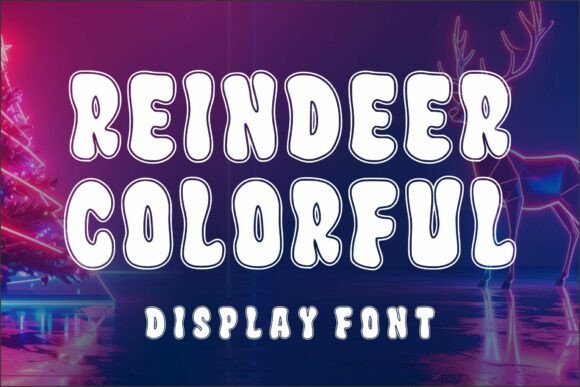
To evaluate Reindeer Colorful effectively, one must first understand its structural DNA. It is not merely a font with red and green letters; rather, its defining characteristic lies in its irregular, hand-lettered geometry. The strokes vary in thickness, mimicking the natural imperfections of brush or marker work. This "chunky" quality gives the text a tactile, three-dimensional feel, making it appear as though it was sketched directly onto the canvas.
This style places the font firmly in the category of decorative display typefaces. Its primary function is not body copy but headline dominance. The bright, cheerful vibes mentioned in its description are achieved through a combination of rounded terminals and exaggerated curves. These features soften the message, making it approachable and friendly. In a practical sense, this means Reindeer Colorful excels when the goal is to capture attention quickly and convey a sense of fun without requiring the viewer to decode complex letterforms. It bridges the gap between professional graphic design and the warmth of homemade crafts.
Visual Weight and Readability Tradeoffs
A critical factor in selecting any display font is the tradeoff between visual weight and readability. Reindeer Colorful possesses significant visual weight due to its thick strokes and dense construction. While this makes it excellent for large-scale applications like posters or social media banners, it introduces limitations for smaller formats. When scaled down for business cards or fine print on packaging, the intricate details of the hand-drawn style can blur, reducing legibility.
Designers must consider the viewing distance of their audience. If the text needs to be read from across a room or scanned quickly on a mobile screen, the bold nature of this font serves well. However, if the design requires extended reading or detailed information delivery, relying solely on this typeface would be a strategic error. It is best utilized as an accent or title element, paired with a simpler, more neutral font for supporting text to maintain visual hierarchy and clarity.
Comparing Reindeer Colorful to Alternative Styles
In the broader context of holiday typography, several categories compete for attention. Understanding how Reindeer Colorful compares to these alternatives helps clarify its specific niche. The most common alternative is the traditional calligraphic script, often featuring elegant loops and flourishes reminiscent of Victorian-era invitations. While scripts convey sophistication and nostalgia, they lack the energetic punch of the hand-drawn style found in Reindeer Colorful.
Another prevalent category includes geometric sans-serifs with holiday color fills. These fonts offer clean lines and modern aesthetics but often feel sterile compared to the organic, imperfect nature of the Reindeer style. Where geometric fonts suggest a corporate or polished event, Reindeer Colorful suggests community, celebration, and informality. This distinction is vital for brand alignment. A luxury retailer might find the playful, chunky strokes too casual for their identity, whereas a children's bookstore or a family-oriented charity event would likely find it perfectly aligned with their values.
Furthermore, there are vector-based clip-art fonts that rely heavily on external graphics rather than the letterform itself. Reindeer Colorful stands apart because the character is inherent in the typeface structure. Even without additional embellishments like snowflakes or holly, the font retains its festive identity. This self-sufficiency offers greater flexibility in layout design, allowing the typography to stand alone as the focal point without cluttering the composition with excessive graphical elements.
Ideal Use Cases and Application Scenarios
The versatility of Reindeer Colorful extends across various mediums, provided the scale and context are appropriate. Its robust structure makes it particularly well-suited for physical merchandise where durability and visibility are key. On T-shirt designs, the thick lines ensure the text remains crisp even after repeated washing, and the playful style resonates well with casual holiday wear. Similarly, for tote bags and mugs, the font's cheerful demeanor enhances the product's appeal as a gift item.
In the realm of print marketing, the font shines in Christmas cards and party invitations. Here, the hand-drawn aesthetic evokes a personal touch, suggesting that the invitation was crafted with care rather than mass-produced by a machine. This perceived authenticity can increase engagement rates for event invites. Posters and signage also benefit from the font's ability to command attention in busy environments, such as shopping malls or school halls, where competing visual stimuli are abundant.
Digital applications present another strong avenue for use. Social media stories, headers for blog posts about holiday recipes, and promotional emails for seasonal sales can all leverage the font's vibrant energy. However, digital usage requires careful consideration of file size and rendering. Because of the complex shapes involved, web implementation should utilize optimized web fonts to prevent slow loading times, ensuring the user experience remains smooth despite the decorative nature of the type.
Decision Factors: When to Choose or Avoid
Selecting Reindeer Colorful ultimately depends on the specific goals of the project. It is the right choice when the objective is to communicate joy, informality, and creativity. If the target audience is families, children, or groups looking for a lighthearted celebration, this font aligns perfectly with those expectations. It works best when the design brief calls for a departure from the formal and traditional, aiming instead for a modern, spirited interpretation of the holidays.
Conversely, there are scenarios where this font may be counterproductive. Projects requiring a sense of solemnity, high-end luxury, or historical accuracy should look elsewhere. The playful, cartoonish elements of the font can undermine messages that need to be taken seriously. Additionally, if the design relies on minimalism, the heavy strokes of Reindeer Colorful might overwhelm the layout, leaving little negative space for balance. In such cases, a thinner, more understated typeface would serve the design better.
Cost and licensing are also practical considerations. As a specialized display font, it may come with different licensing terms compared to standard system fonts. Designers should verify that the license covers their intended commercial use, whether that involves selling printed goods, digital downloads, or large-scale advertising campaigns. Understanding these logistical constraints ensures that the creative vision can be executed without legal complications later.
Integrating Reindeer Colorful into a Broader Strategy
Even when Reindeer Colorful is the chosen headline font, it rarely works in isolation. Successful design involves pairing it with complementary elements to create a cohesive visual language. A practical approach is to pair it with a clean, neutral sans-serif for body text. This contrast allows the personality of the display font to shine while maintaining overall readability. The simplicity of the secondary font acts as a visual rest, preventing the viewer from becoming fatigued by the complexity of the main title.
Color palette selection also plays a crucial role in maximizing the font's potential. While the name implies color, the font itself is typically delivered in a single color with the option to apply gradients or fills. To enhance the "bright, cheerful vibes," designers can experiment with warm tones like gold, crimson, and forest green, or opt for unexpected pastel combinations for a modern twist. The chunky nature of the letters holds gradient fills well, adding depth without losing definition.
Ultimately, the decision to use Reindeer Colorful should be driven by the desired emotional response from the audience. It is a tool for injecting personality and warmth into holiday communications. By evaluating the project's scale, audience expectations, and brand identity against the font's distinctive characteristics, designers can make informed choices that elevate their work. Whether for a simple greeting card or a comprehensive marketing campaign, understanding the strengths and limitations of this typeface ensures it serves the design purpose effectively.