Night Fall Spooky: A Design Evaluation
In the realm of seasonal typography, designers often face a specific challenge: balancing legibility with thematic atmosphere. Night Fall Spooky is a display font designed to address this tension, offering a bold aesthetic that merges eerie visual cues with playful elements. For those evaluating typefaces for Halloween projects, understanding the specific characteristics, strengths, and limitations of this font is essential for making an informed selection.
Understanding the Visual Identity
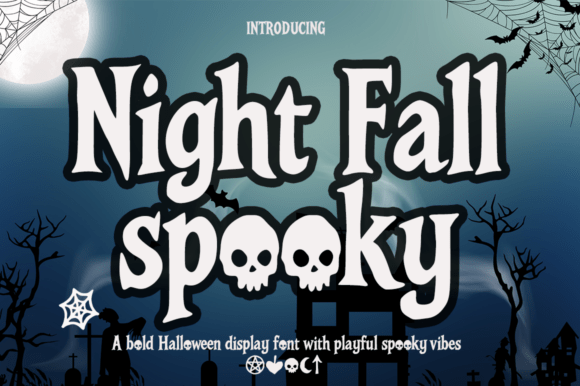
Night Fall Spooky is defined by its chunky, hand-drawn appearance. Unlike serif or sans-serif fonts intended for body text, this is a display typeface meant for headlines, titles, and short bursts of text. The letterforms are characterized by thick strokes and uneven edges, mimicking the look of marker or paint applied with a freehand style. This irregularity contributes to a sense of movement and organic texture, distinguishing it from rigid, geometric horror fonts.
A defining feature of the design is the inclusion of spooky outlines and skull-themed alternates. These decorative glyphs allow for customization within a single word, enabling designers to inject specific motifs—such as skulls or bones—directly into the typography without needing external graphic assets. The overall impression is one of festive personality rather than genuine terror, positioning the font in the "spookily fun" category rather than the "gritty horror" niche.
Reasons for Interest and Target Use Cases
Designers and content creators may find Night Fall Spooky appealing when their goal is to communicate a lighthearted Halloween theme. The font's readability, despite its stylized nature, makes it particularly useful for projects where the audience includes children or families. Because the letterforms remain distinct and the spacing is generally generous, the text does not devolve into illegible scribbles, even at moderate sizes.
The font is well-suited for several specific applications:
- Halloween Posters and Flyers: The bold weight ensures visibility from a distance, while the thematic details capture attention immediately.
- Party Invitations: The playful tone sets expectations for a fun event rather than a frightening experience.
- Trick-or-Treat Signs: The high contrast and chunky shapes make the text easy to read quickly on doorsteps.
- Educational Projects: Teachers can use the font for classroom decorations or worksheets where a festive look is required without causing distress to young students.
- Merchandise Packaging: Product labels for candy, costumes, or seasonal goods benefit from the eye-catching nature of the design.
Benefits and Practical Advantages
The primary advantage of Night Fall Spooky is its ability to convey a complete mood through typography alone. By integrating outlines and alternate characters, it reduces the need for complex layering or additional graphic design work. This efficiency is valuable for users who need to produce designs quickly, such as event organizers or small business owners preparing seasonal marketing materials.
Furthermore, the hand-drawn aesthetic adds a human touch that vector-based, perfectly symmetrical fonts often lack. This imperfection aligns well with the DIY spirit of many Halloween traditions, from homemade costumes to neighborhood decorations. The font's versatility allows it to function effectively in both digital formats, such as social media graphics, and print media, provided the resolution is maintained.
Tradeoffs and Limitations
While Night Fall Spooky excels in specific contexts, it is not a universal solution for all Halloween-related text. As a display font, it suffers from reduced legibility when used for long paragraphs or body copy. The thick strokes and decorative elements can cause letters to blur together at smaller point sizes, making it unsuitable for detailed instructions, legal disclaimers, or lengthy descriptions.
Additionally, the playful nature of the font may not align with projects aiming for a serious, mature, or genuinely terrifying aesthetic. If a project requires a dark, gothic, or realistic horror vibe, the whimsical qualities of this typeface might undermine the intended atmosphere. Users must also consider that the heavy outlines can consume significant white space, potentially limiting how much text fits on a page or screen compared to lighter fonts.
When to Consider Alternatives
There are scenarios where selecting a different typeface would be more prudent. If the design brief calls for a sophisticated or elegant Halloween theme, such as a formal gala or a high-end brand campaign, the cartoonish quality of Night Fall Spooky may appear too juvenile. In these cases, a refined Gothic script or a minimalist serif font with subtle horror accents would likely serve the project better.
Similarly, for accessibility purposes, users should exercise caution. The uneven baselines and decorative ligatures can pose challenges for individuals with dyslexia or other reading difficulties. If the target audience includes a broad demographic where accessibility is a priority, pairing this font with a highly readable sans-serif for body text is necessary, or choosing a simpler display font altogether.
Finally, if the project involves multi-language support, it is crucial to verify the character set included with the font. Many display fonts focus exclusively on English characters and basic punctuation. If the design requires special characters for other languages, Night Fall Spooky may not provide the necessary coverage, necessitating a search for a more comprehensive alternative.
Decision-Making Insights
To determine if Night Fall Spooky aligns with your goals, evaluate the primary emotion you wish to evoke. Ask whether the project aims to entertain and delight or to unsettle and frighten. If the former, this font is a strong candidate. If the latter, explore options with sharper angles, darker tones, and less ornamentation.
Consider the hierarchy of your design. Reserve Night Fall Spooky for headlines and focal points where its impact will be maximized. Always pair it with a neutral, clean typeface for supporting text to ensure the overall composition remains balanced and readable. By treating the font as a specialized tool rather than a default choice, you can leverage its unique character without compromising the clarity or professionalism of your final design.