Mastering Letter Formation: The Power of Bold Outlined Tracing Fonts in Early Education
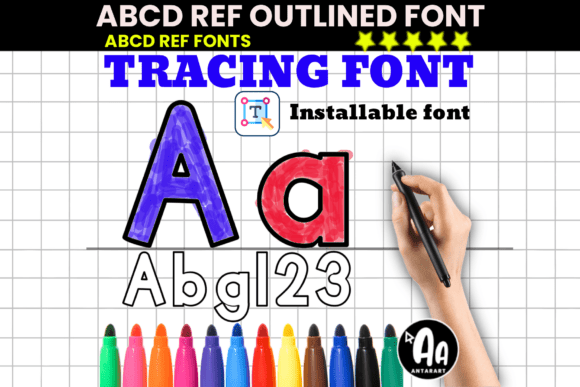
In the journey of early childhood development, few milestones are as significant as learning to write. For young learners, transforming abstract shapes into recognizable letters and numbers is a complex cognitive and physical task. To bridge the gap between recognition and production, educators and parents rely on specialized tools designed to make this process intuitive and engaging. One such tool that has gained immense popularity in modern classrooms and homes is the ABCD REF Outlined Font. This unique typeface, characterized by its bold, hollow letters with clean edges, serves as more than just a decorative element; it is a functional educational resource tailored for coloring and tracing activities.
The Educational Philosophy Behind Hollow Letters
At first glance, a font might seem like a simple aesthetic choice—a way to make text look different on a page. However, in the context of early literacy, the design of a font carries profound pedagogical weight. The ABCD REF Outlined Font is specifically engineered to support kinesthetic learning. Unlike solid fonts where the ink fills the entire letter shape, this font features hollow interiors. This design invites children to fill in the empty space, turning the act of writing into a creative coloring activity.
This approach addresses two critical developmental areas simultaneously:
- Fine Motor Skill Development: Tracing within defined boundaries requires precise hand-eye coordination. As children navigate the curves and lines of the bold outlines, they strengthen the small muscles in their hands and fingers, which is essential for controlling a pencil or crayon later on.
- Letter Recognition and Formation: By repeatedly tracing the same shape, children internalize the structure of each character. The bold outlines provide a clear visual guide, reducing frustration and helping learners understand the correct directionality and stroke order of letters.
The font adheres to traditional school handwriting styles, ensuring that what children practice aligns with standard curriculum expectations. It includes uppercase and lowercase letters, numbers 0–9, and common symbols, allowing for comprehensive practice tasks that go beyond just the alphabet.
Bridging the Gap Between Play and Learning
One of the most common challenges teachers face is maintaining student engagement during repetitive drills. Handwriting practice can often feel tedious for young minds. The ABCD REF Outlined Font transforms this dynamic by integrating playfulness into the learning process. Because the letters are designed to be colored in, they naturally attract children who enjoy art and creativity. When a child colors inside the lines of a giant "A" or traces a "B", they are not just following instructions; they are creating something visually appealing.
This dual-purpose nature makes the font ideal for a variety of settings:
- Classroom Displays: Teachers can use the font to create vibrant bulletin board letters that serve as daily references for students.
- Interactive Worksheets: Printable practice sheets can be generated instantly, offering endless variations for back-to-school reviews or targeted alphabet practice.
- Customized Student Materials: From editable name templates to personalized handwriting books, the font allows for materials that speak directly to the individual learner.
Practical Applications for Educators and Parents
The versatility of the Alphabet Letters Formation Font extends far beyond the printed page. In an era where digital tools are ubiquitous in education, having a font that seamlessly integrates with popular software is a significant advantage. This installable font is fully compatible with a wide range of applications, including Microsoft Word, PowerPoint, Canva Pro, Adobe programs, Paint, Inkscape, and GIMP.
Creating Dynamic Classroom Resources
For teachers, time is a precious commodity. The ability to quickly generate high-quality resources is invaluable. With this font, creating a lesson plan becomes more efficient. Imagine designing a PowerPoint presentation where the title letters are large, outlined, and ready for students to trace on their tablets or printed copies. Or consider using Canva Pro to design colorful posters that highlight specific phonics sounds, utilizing the bold outlines to draw attention to the letter shapes.
The font's compatibility with vector-based programs like Inkscape and GIMP also opens up possibilities for professional-grade graphic design. Educators can resize the letters without losing quality, making them perfect for everything from small desk labels to large classroom banners. This scalability ensures that the font remains useful throughout the academic year, adapting to various project sizes and needs.
Supporting Home Learning Environments
Parents seeking to support their children's literacy at home will find this font equally beneficial. The ease of installation means that families can start creating custom worksheets immediately. Whether it is practicing numbers for counting exercises or forming names for self-identity building, the font provides a structured yet fun framework. The bold outlines are particularly helpful for children who struggle with staying within lines, providing a forgiving and encouraging environment for practice.
It is important to note, however, that while the font is robust, it does have specific limitations. Note: This font does not support Spanish characters. Users working in bilingual environments or teaching Spanish as a second language should be aware of this constraint and may need to supplement with other resources for accented characters. Despite this, for English-language instruction and general numeracy, it remains a top-tier choice.
Common Misconceptions About Tracing Fonts
A frequent misunderstanding among parents and new educators is the belief that tracing is merely a passive activity that hinders independent writing skills. Some argue that children should be encouraged to freehand write immediately to foster creativity. However, research in early childhood development suggests otherwise. Tracing acts as a scaffold—a temporary support structure that helps learners build confidence before attempting independent tasks.
The ABCD REF Outlined Font exemplifies this scaffolding approach. By providing a clear, bold boundary, it reduces the cognitive load on the child. Instead of worrying about how big to make the letter or where to start the stroke, the child can focus on the movement and the shape itself. Once the muscle memory is established through repeated tracing, the transition to freehand writing becomes much smoother and more natural.
Furthermore, there is a misconception that "handwriting fonts" are only for cursive writing. This font, however, focuses on print handwriting, which is the foundational style taught in most early education systems. Its clean edges and traditional style ensure that children develop proper letter formation habits from the very beginning, avoiding the confusion that can arise from mixing script and print styles too early.
Enhancing Confidence Through Visual Feedback
One of the most subtle yet powerful aspects of using bold outlined fonts is the immediate visual feedback they provide. When a child successfully fills in a letter or traces along the edge, the result is a complete, solid shape. This tangible outcome reinforces a sense of accomplishment. In contrast, struggling with faint lines or invisible guides can lead to frustration and a lack of confidence.
The "bold" aspect of the font is not just for show; it serves a functional purpose. Thicker lines are easier for developing eyes to track and for developing hands to follow. This design consideration shows a deep understanding of the user experience for young learners. It acknowledges that the path to literacy is built on small, successful steps, and every completed worksheet is a victory worth celebrating.
Conclusion: A Vital Tool for Modern Literacy
As we continue to evolve our educational methods, blending technology with traditional pedagogy, tools like the ABCD REF Outlined Font become increasingly relevant. They represent a harmonious intersection of design, psychology, and education. By offering a solution that is both easy to use for adults and engaging for children, this font empowers teachers and parents to create rich, interactive learning environments.
Whether you are preparing for back-to-school season, designing a new curriculum, or simply looking for ways to help your child practice their ABCs, the value of a well-designed tracing font cannot be overstated. It builds the foundation for lifelong literacy, fostering not just the ability to write, but the confidence to express oneself. With its broad compatibility, inclusive character set (excluding Spanish accents), and focus on motor skill development, it stands out as an essential resource for anyone dedicated to nurturing the next generation of writers.